



Once a Dubai company decides to hire you, the next big step is the work visa — the set of approvals that legally lets you live and work in the UAE. It sounds complicated, but the process is well-defined and, in 2026, largely digital. This guide walks you through exactly how a Dubai work visa is issued, what it costs, who pays, the documents you need, and how long it takes.
What a Dubai work visa actually is
A Dubai work visa (employment visa) isn’t a single document — it’s a combination of government approvals issued through the Ministry of Human Resources and Emiratisation (MOHRE) and the General Directorate of Residency and Foreigners Affairs (GDRFA). Together they give you a work permit, a residence visa, and an Emirates ID. Importantly, the residence visa is digital and linked to your Emirates ID: it has not been stamped in passports since April 2022 (ICP announcement).
Types of UAE work visa
The employment visa is the one most people need, but it isn’t the only way to work in the UAE:
- Employment visa (most common). Sponsored by your employer for a full-time job, valid for two years and renewable (u.ae: work visa). This is the visa the rest of this guide covers.
- Freelance or self-employment visa. For independent professionals without a single employer, issued through UAE free zones. See our freelance visa guide.
- Green Visa. A five-year, self-sponsored residence visa for skilled employees, freelancers and investors who meet the criteria, so no employer sponsor is needed (ICP Green Residence guide).
- Golden Visa. Long-term residency of up to 10 years for investors, entrepreneurs, exceptional talent and outstanding students. See our Golden Visa guide.
- Mission work permit. Lets a company bring in a worker from abroad for a specific temporary job or time-bound project (u.ae: work permit types).
The step-by-step process
- Job offer and labour quota. Your employer issues an official offer and ensures it has an available MOHRE labour quota to hire you.
- MOHRE work permit. The company applies for your work permit (labour approval). This is usually approved in 2–5 working days.
- Entry permit. Once the permit is approved, an entry permit is issued so you can legally enter (or change status if you’re already in the UAE).
- Medical fitness test. Every applicant aged 18+ takes a medical test, including screening for infectious diseases.
- Emirates ID application. You apply for your Emirates ID (biometrics and photo).
- Residence visa issued. The residence visa is finalised and linked to your Emirates ID, completing the process.
Most of these steps are now handled digitally through MOHRE and GDRFA systems, which has made the process faster than in previous years.
How much it costs — and who pays
This is the part many job seekers don’t realise: by law, your employer pays 100% of the work visa cost. Under Federal Decree-Law No. 33 of 2021, companies cannot charge the employee recruitment or employment fees, which include your work permit and residence visa. The UAE government portal puts it plainly: charging recruitment fees to prospective employees is illegal (u.ae: protection of workers’ rights). If an employer asks you to pay for your own work visa, that is a red flag.
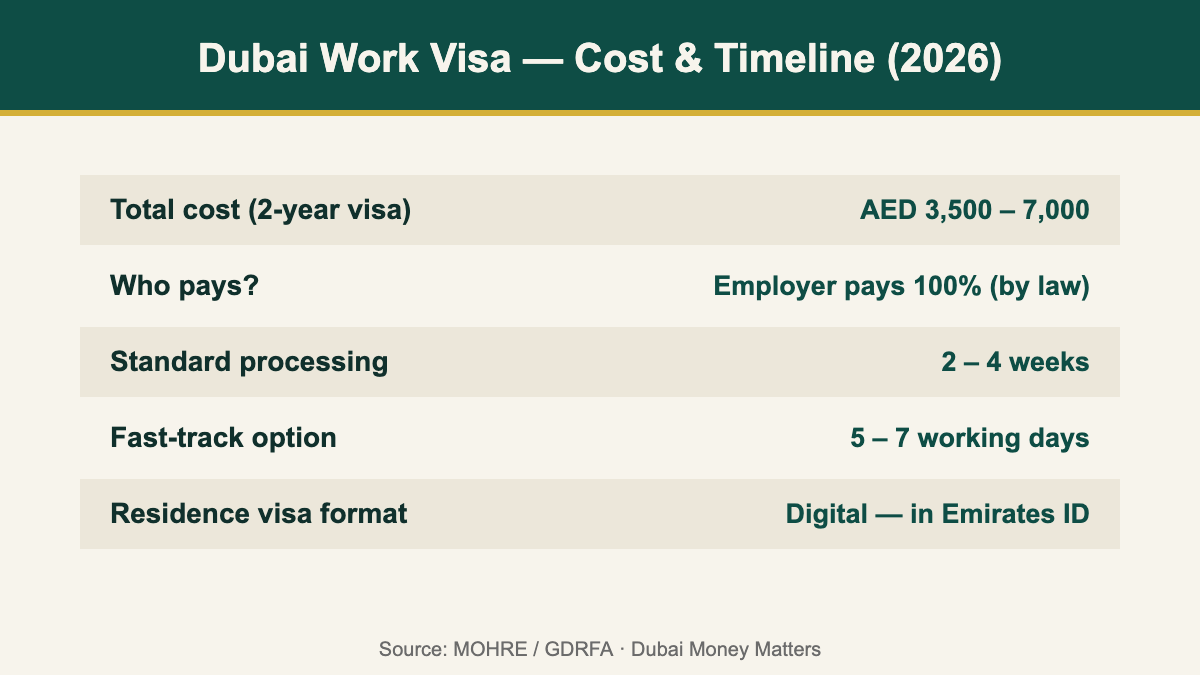
| Item | Detail |
|---|---|
| Total cost (standard 2-year visa) | AED 3,500 – 7,000 |
| Who pays | Employer (100%, by UAE law) |
| Standard processing time | 2 – 4 weeks |
| Fast-track option | 5 – 7 working days (extra AED 500 – 1,000) |
| Covers | Work permit, entry permit, medical, Emirates ID, residence visa |
The total and fast-track figures are typical estimates, not official fees, and your employer pays them either way. The official part you can check is the MOHRE work permit itself, which costs AED 250 to AED 3,450 depending on the company’s classification (u.ae: work permits).
Documents you’ll need
- Passport valid for at least 6 months, with a clear scan
- Recent colour photos with a white background
- Attested educational certificates (degree/diploma attested in your home country and by the UAE embassy there)
- The official MOHRE-approved employment contract, signed by both you and the employer
- Your entry permit and, where relevant, proof of current UAE status
Getting your certificates attested early is the single best way to avoid delays — it’s the step that most often holds people up.
How long the whole process takes
For a typical skilled role, the full file is usually completed within two to four weeks once the company’s labour quota is in place. If you or your employer need it faster, fast-track processing can bring it down to about 5–7 working days for an extra fee.
Things worth knowing
- You usually don’t need to leave the country. If you’re already in the UAE (for example on a visit visa), your status can often be changed in-country.
- Keep digital copies. Since the visa lives in your Emirates ID, keep PDF copies of your visa and ID for opening bank accounts, tenancy and more.
- Never pay for your own employment visa. It’s the employer’s legal responsibility.
- Check the contract carefully before signing — salary, job title, and terms should match what you agreed.
- Your visa is tied to your employer. If you leave or lose the job, the visa is cancelled and a grace period starts to find a new job or leave the UAE. For private-sector employees in Dubai it is 60 days; across the UAE it ranges from 30 days to six months depending on your visa category (u.ae: grace periods).
- You can change jobs without leaving the UAE. Your new employer applies for a new work permit and the visa moves over; you don’t need to exit the country.
- You can only work for your sponsor unless you hold a separate permit (such as a MOHRE part-time permit) or a freelance or Green Visa.
- You can sponsor your family once you earn at least AED 4,000 a month, or AED 3,000 plus employer housing (u.ae: family residence visa). See minimum salary to sponsor your family.
Frequently asked questions
Do I pay for my Dubai work visa?
No. UAE law requires the employer to cover 100% of employment-visa costs. Being asked to pay is a warning sign.
How long does a Dubai work visa take in 2026?
Usually 2–4 weeks, or about 5–7 working days with fast-track processing.
Is the visa stamped in my passport?
No longer. The residence visa is digital and linked to your Emirates ID.
Do I need attested certificates?
For most skilled roles, yes — your degree must be attested in your home country and by the UAE embassy. Start this early.
Can I change from a visit visa to a work visa without leaving the UAE?
In most cases yes, through an in-country change of status handled by your employer.
How long is the work visa valid?
Standard employment visas are typically valid for two years and renewable while you remain employed. Green Visas run for five years and Golden Visas for up to 10.
Can I work in the UAE on a tourist or visit visa?
No. A visit or tourist visa does not give you the right to work, and working on one leads to fines and legal liability, which can include deportation and a re-entry ban (u.ae: avoiding visa fraud). Your employer must get you a work permit first.
Can I change jobs without losing my visa?
Yes. You can move to a new employer from inside the UAE; the new company applies for your work permit and the visa transfers.
What happens to my visa if I lose my job?
The visa is cancelled and a grace period starts (60 days for most private-sector employees in Dubai, longer for some visa categories), during which you can find a new job or leave the UAE.
Visa rules and fees are set by MOHRE and GDRFA and can change. Always confirm current requirements via the official channels: MOHRE, GDRFA Dubai, ICP and the UAE Government portal u.ae. This article is general information, not legal or immigration advice.