



Getting the interview is only half the battle — in Dubai’s competitive market, how you handle the interview itself decides whether you get the offer. The good news is that most Dubai interviews revolve around the same handful of questions, and once you know what employers are really asking, you can prepare calm, confident answers. This guide covers the most common Dubai job interview questions, how to answer each one, and the practical tips that put you ahead of most applicants.
What Dubai interviewers actually look for
UAE interviews are not about perfect English or long speeches. Employers here are looking for calm confidence, clear answers, professionalism, and signs that you will be a stable, reliable hire. Cultural awareness and honest communication matter more than flawless grammar. Keep your answers structured and to the point, and you are already ahead of most candidates.
A few cultural points help too. Business here is fairly formal and hierarchical, so show respect for seniority, be punctual (lateness is read as disrespect), and give direct, specific answers rather than vague ones.
Common Dubai interview questions and how to answer them
1. “Tell me about yourself.”
Give a 90-second professional summary, not your life story. Cover your qualifications, your most relevant experience, and finish with why you’re drawn to this role in Dubai. Keep it focused on what’s useful to the employer.
2. “Why do you want to work in Dubai / the UAE?”
Go beyond “tax-free salary.” Mention Dubai’s status as a global business hub, its growth and innovation, and your genuine interest in building your career here. Employers want people who plan to stay and contribute, not just pass through.
3. “Why this company and this role?”
Show you’ve done your research. Reference something specific about the company and connect your skills to what the role needs. This is where most candidates are vague — being specific sets you apart.
4. “What are your salary expectations?”
Research the market rate for your role before the interview, then give a specific, researched range anchored toward the upper end. Avoid naming a single low number out of nervousness. It’s fine to say you’re flexible for the right opportunity. Think in terms of the full package (basic salary plus housing, transport and health insurance), and never answer “whatever you offer”, which reads as a lack of confidence. For scripts, see how to negotiate salary in Dubai.
5. “Do you have UAE experience?”
If you don’t, don’t apologise. UAE experience helps but isn’t always required. Emphasise how quickly you adapt, your awareness of the local work culture, and your readiness to start. Confidence here matters more than the gap.
6. “What are your strengths and weaknesses?”
For strengths, pick ones relevant to the role and back them with a quick example. For weaknesses, name a real but non-critical one and show how you’re actively improving it — never “I’m a perfectionist.”
7. “Why are you leaving your current job?”
Stay positive. Frame it as seeking growth, new challenges or a better fit — never criticise a former employer, as Dubai’s professional community is small and reputation travels.
8. “Where do you see yourself in five years?”
Show ambition that fits the company. Mention growing your skills and taking on more responsibility within the organisation, signalling that you intend to stay and develop.
9. “When can you join, and what’s your visa status?”
Be clear and positive: state your notice period or that you’re available immediately, your current visa status, whether you’re in the UAE or overseas, and whether you’ll need visa sponsorship. Employers value candidates who can start without complications.
Answering “tell me about a time…” questions: the STAR method
Competency questions such as “Tell me about a challenge you overcame” are easier with a simple structure:
- Situation: briefly describe the context.
- Task: what you were responsible for.
- Action: the specific steps you took.
- Result: the outcome, with numbers where you can.
Example: “When our team missed a quarterly target (S), I was asked to rebuild the sales plan (T). I introduced daily performance tracking and weekly coaching sessions (A). Within 60 days we were back above target (R).”
Questions to ask the interviewer
Almost every interview ends with “Do you have any questions?” Have a few ready, such as:
- “What does success look like in this role in the first six months?”
- “What are the main challenges the team is facing?”
- “How would you describe the company culture?”
- “What are the opportunities for growth and development?”
Don’t raise salary, benefits or leave yourself in a first interview; wait until the employer brings it up or you have an offer.
Video interviews
Many Dubai employers hold the first round on Zoom, Teams or Google Meet. Treat it exactly like an in-person interview:
- Dress formally, head to toe.
- Use a clean, tidy, well-lit background.
- Log in and test your audio and video 15 minutes early.
- Look at the camera, not the screen, to keep eye contact.
- Keep your CV open for reference, and silence your phone.
Interview day: a simple checklist
Preparation on the day makes a real difference. Keep this checklist in mind:
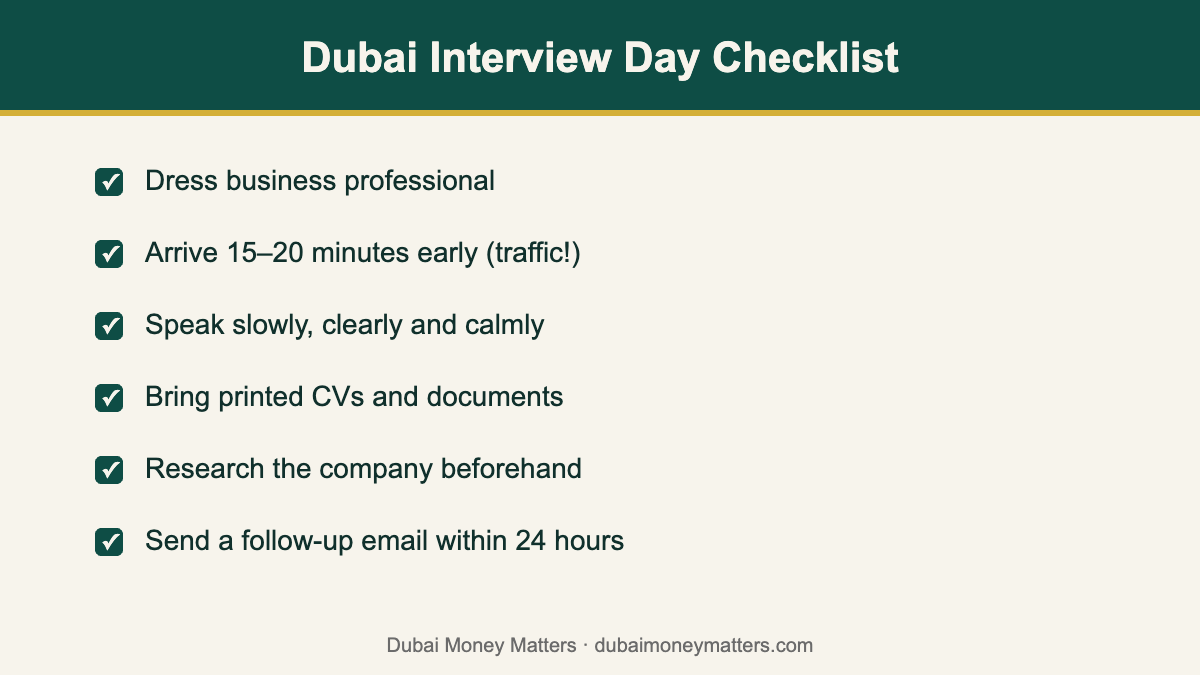
- Dress business professional. Dubai leans formal — smart, conservative attire is the safe choice: a dark suit for men, professional and conservative business wear for women, minimal jewellery. If in doubt, overdress.
- Arrive 15–20 minutes early. Traffic is unpredictable; being late is hard to recover from.
- Speak slowly, clearly and calmly. Clear, honest communication beats fast, perfect English.
- Bring printed CVs and your documents (passport copy, certificates, Emirates ID if you have one).
- Research the company so you can ask one or two thoughtful questions at the end.
After the interview: the step most people skip
Send a short, professional follow-up email within 24 hours, thanking the interviewer and restating your interest. Very few candidates in the UAE do this, so it’s a genuine differentiator that keeps you top of mind while decisions are made. Keep it to three or four sentences and mention one specific thing from the conversation.
If you hear nothing back, wait five to seven working days and send one brief, polite follow-up. More than one can come across as pushy.
Frequently asked questions
How long do Dubai job interviews usually last?
Most run 20 to 45 minutes. There may be more than one round for senior roles, sometimes including an online interview first.
How many interview rounds should I expect?
It varies by company, but a common pattern is an HR screening call, then a technical or skills interview, then a final meeting with a senior manager.
Is it okay to ask about visa sponsorship?
Yes. Employers expect overseas candidates to ask. Keep it direct and professional, for example: “Can you confirm that visa sponsorship is included for this role?”
Do I need perfect English to pass a Dubai interview?
No. Clear, confident, honest communication matters far more than perfect grammar. Speak slowly and structure your answers.
What should I wear to an interview in Dubai?
Business professional attire — formal and conservative is the safest choice across most industries.
Should I negotiate salary in the interview?
Give a researched range when asked, but the real negotiation usually happens at the offer stage. Know your market value beforehand.
Is a follow-up email really worth sending?
Yes. A brief thank-you email within 24 hours is a simple, powerful way to stand out, because most candidates never send one.
This article is general career guidance. Interview practices vary by company and industry. For role-specific salary benchmarks, check platforms like Bayt, GulfTalent and LinkedIn before your interview.