Opening a bank account is one of the first things you will need to do as a new expat in Dubai — you cannot receive your salary, pay rent or set up most services without one. The good news is that in 2026 the process is faster and more digital than ever. This guide explains exactly what you need, which banks to consider, and how to open your account step by step.
Who can open a bank account in Dubai?
To open a standard resident account, you need a UAE residence visa and an Emirates ID. Once your employment visa is processed and your Emirates ID is issued, you are ready. Tourists and non-residents have more limited options (usually savings-only accounts), so most new expats wait until their residency is done.
Documents you need
- Your passport and residence visa
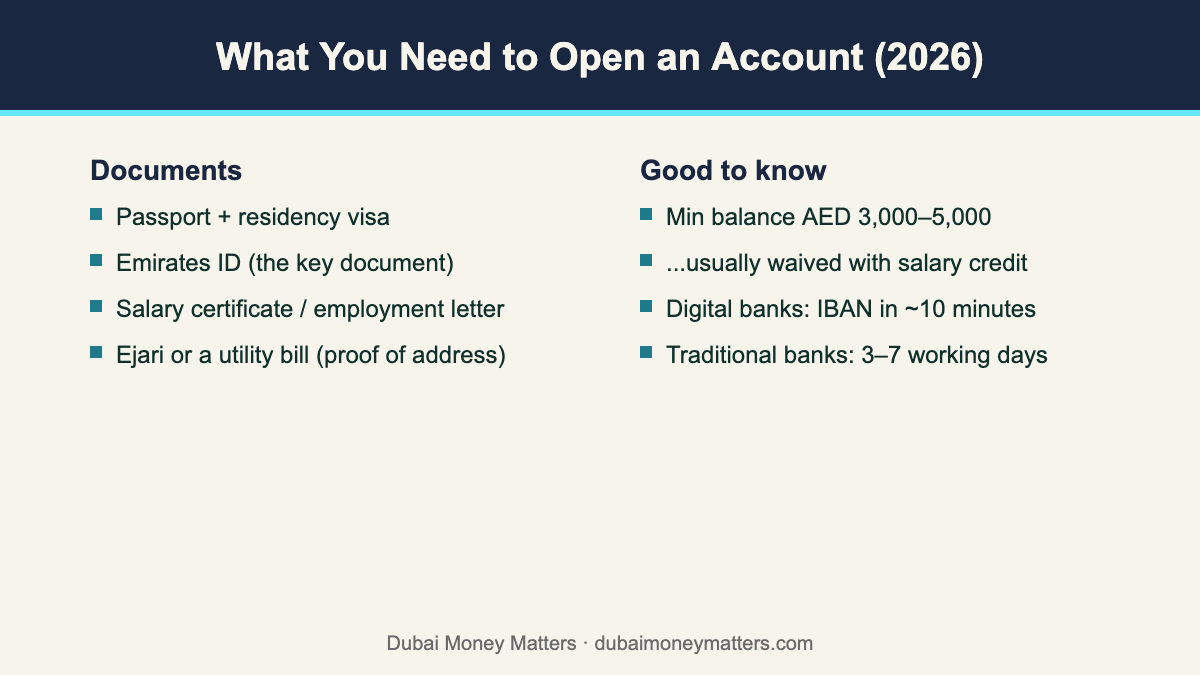
- Your Emirates ID — the primary identity document banks rely on
- A salary certificate or employment letter from your UAE employer
- Proof of address — usually your Ejari (tenancy contract) or a recent utility bill
Minimum balance and salary accounts
Most standard accounts ask for a minimum balance of around AED 3,000–5,000, but this is commonly waived if your salary is credited to the account each month. If you are employed, having your salary transferred (under the Wage Protection System) unlocks better terms, easier credit and more services. A salary account is almost always the best option for employed expats.
Traditional banks vs digital banks
- Traditional banks — Emirates NBD, ADCB and FAB offer large branch and ATM networks and full-service banking. Opening usually takes 3–7 working days.
- Digital banks — app-only options such as Liv and Wio let you open an account and get an IBAN in as little as 10 minutes from your phone, with lower fees.
Many people open a digital account first for speed, then add a traditional bank later if they need branches, loans or mortgages.
Step by step: how to open your account
- Get your Emirates ID first. Most banks need it to open a resident account.
- Choose a bank and account type — a salary account is best if you are employed.
- Gather your documents (passport, visa, Emirates ID, salary certificate, proof of address).
- Apply — in a branch, or entirely through the app with a digital bank.
- Set up your salary transfer to waive the minimum balance and unlock better terms.
How long does it take?
A digital bank can have you running with an IBAN in under 15 minutes. Traditional banks usually take 3–7 working days to fully activate the account.
Tips for new expats
- Open a salary account to avoid minimum-balance fees.
- Compare monthly fees, transfer charges and ATM access before choosing.
- Keep digital copies of your Emirates ID, visa and Ejari ready — you will reuse them constantly.
- A digital account is the fastest way to start receiving money while your paperwork settles.
Frequently asked questions
Can I open a bank account in Dubai without a residence visa?
For a full resident account, no — you need a residence visa and Emirates ID. Non-residents have limited savings-only options at some banks.
What is the minimum balance?
Usually AED 3,000–5,000, but typically waived if your salary is credited to the account.
Which is the best bank for new expats?
It depends on your needs — Emirates NBD, ADCB and FAB for full-service banking, or Liv and Wio for fast app-based accounts.
How fast can I open an account?
As little as 10–15 minutes with a digital bank, or 3–7 working days with a traditional bank.
Do I need a salary certificate?
For a salary account, yes — most banks ask for a salary certificate or employment letter from your UAE employer.
Bank requirements and fees vary by institution and can change. Confirm the latest details directly with your chosen bank. This article is general information, not financial advice.